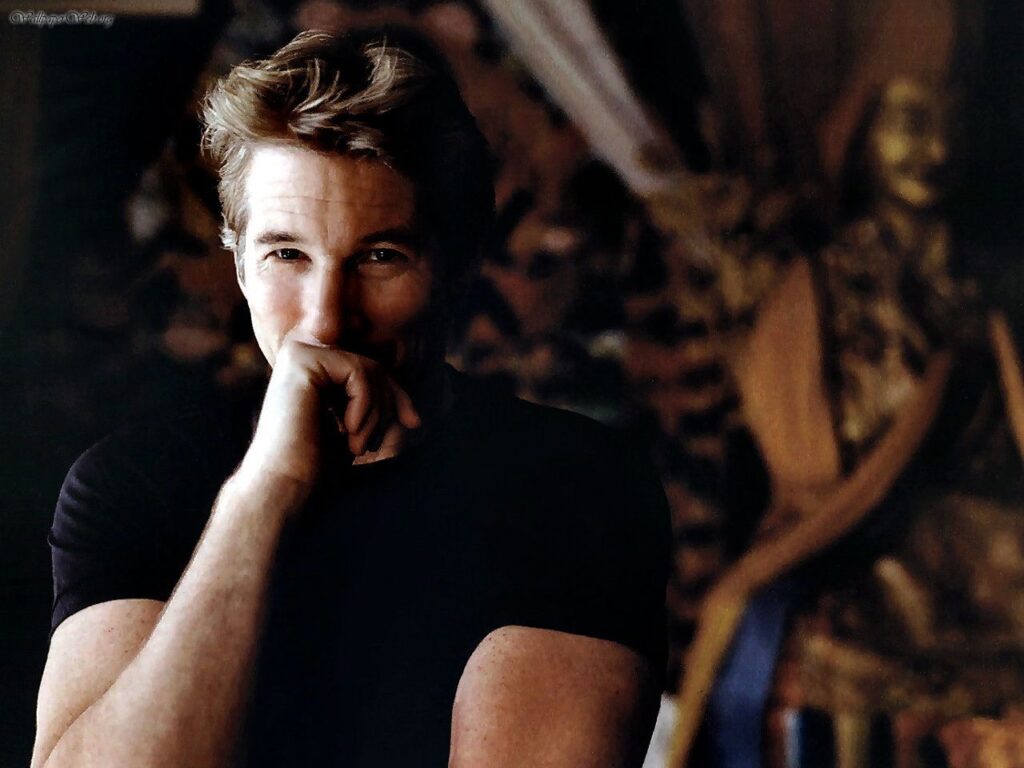
At seventy-five years old, Hollywood’s intellectual, philosopher, and Buddhist Richard Gere smiles wryly when people call him a sex symbol – yet they never stop. Moreover, in his case the tag comes without any obvious nod to a bygone decade like the eighties or nineties, even though one might assume it would.
Richard Tiffany Gere was born August 31, 1949, in Philadelphia but spent his childhood in North Syracuse, New York – a town of just five thousand people with a single movie theater aptly named “Hollywood.” His parents, Homer George Gere and Doris Anna Tiffany, descended from English and Irish Pilgrims who crossed on the Mayflower – American aristocrats by local standards. His father worked as an insurance agent; his mother was a homemaker. The couple raised five children – three daughters and two sons – and Richard was the second child and eldest son.
When feeling playful, Gere tells journalists how he ran away with a traveling circus as a youth, since his artistic leanings found no sympathy at home. Yet, when serious, he offers a different picture: “We were all musicians, and our house had a wonderful atmosphere.” He learned piano, guitar, and trumpet and performed in school plays in roles from Santa Claus to the President of the United States. His parents encouraged it all, and one of his sisters later became an actress.
“They nurtured me in every respect,” he recalls. “I remember ballroom dance lessons in elementary school. I was a tall kid, and the girls were even taller… We’d spin around the room, and I’d feel simply awful. Our teacher, Mr. Graunau, competed in contests, traveled to New York and Atlantic City. For a small town, that was astonishing—someone actually reached the big world…”
The ’60s Counterculture
“In the ’60s, we were all swept up in the counterculture—long hair, flower crowns,” he laughs. “You couldn’t live through those years without getting drawn in. I even tried to walk on foot to Kathmandu, but that plan fizzled. What an incredible time! Our parents dreamed of cutting our hair and teaching us proper manners. Just the other day I found a photo of myself from back then… Oh my God! There I was with hair down to here and bristling with bracelets. It was utter madness!”
On the Electric Chair
“Early in my film career, I was cast in a small independent movie,” Gere explains. “It meant a lot because I came from theater. In theater, work can be scarce—I barely managed to support myself. So I went to the final rehearsal before shooting, and the director looked at me simply staring at the floor. Finally, still looking down, he said, ‘I’m sorry, but we have to let you go. You can leave.’ It was winter—freezing cold—and I don’t even remember getting home. I climbed into bed in my coat and boots, covered myself up, and stayed that way for days. But hey, I survived…”
His filmography officially begins in 1973 with bit parts in the TV movie Chevy Chase’s H.O. and an episode of Columbo, titles now known only to specialists. The next year he landed one of the four leads in the low-budget drama The Lords of Flatbush, but tensions on set led to a fight, and the director replaced Gere with Perry King—leaving a young Sylvester Stallone in the film.
In the early ’70s Hollywood offered him only small roles—Report to the Commissioner, Force 10 from Navarone, The Solid Gold Cadillac—but on stage he starred in Sam Shepard’s one-man play The Tooth of Crime, delivering a monologue blindfolded in an electric chair: no movement, no props, just voice, intonation, and pause.
Critics and directors took notice. Under Richard Brooks in Looking for Mr. Goodbar, he played a drug-addicted pimp—fifteen minutes of screen time that left a lasting impact. In Terrence Malick’s Days of Heaven he had the lead role, and Paul Schrader’s erotic thriller American Gigolo made him a star.
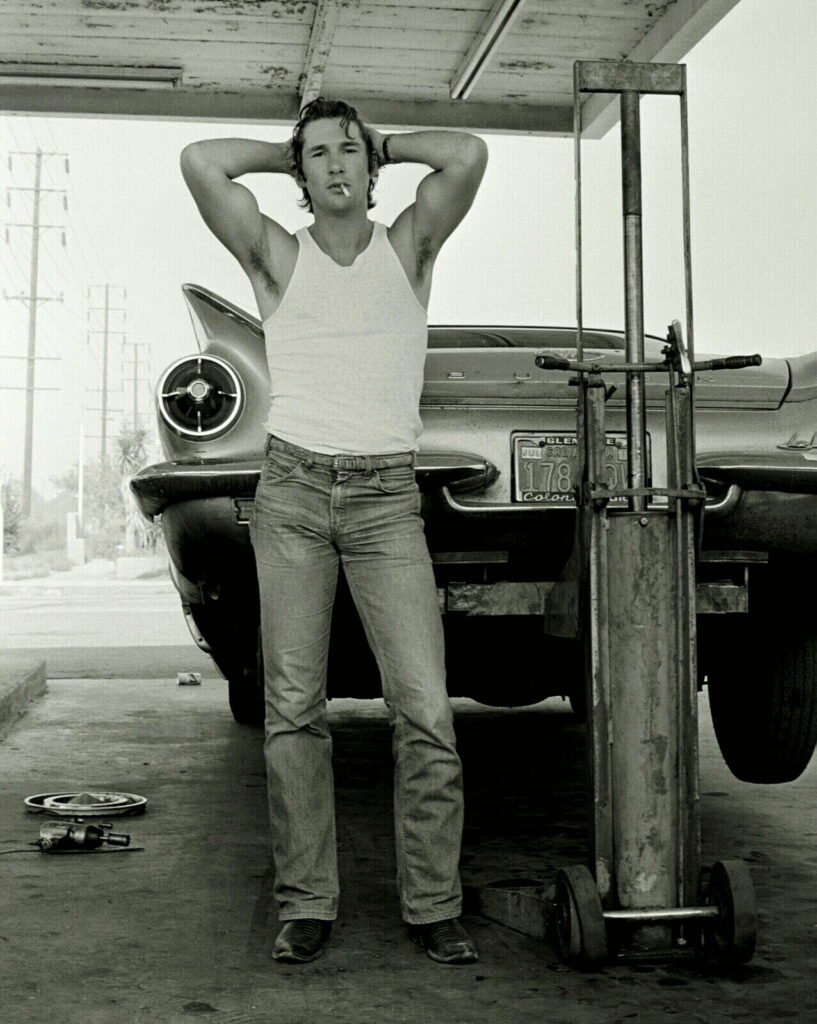
American Gigolo, 1980
“I had never seen my name so big on a marquee,” he says. “Then three of my films opened back-to-back, and I literally woke up famous. It was thrilling—and frightening!”
Resisting the Sex Symbol
Far from a real-life Don Juan or Casanova, Gere endured an avalanche of rumors fueled by his ultra-sexy screen image. “My friends were upset when they read nasty things about me,” he said. “That’s how I heard of each new rumor: I’d meet a friend, and he’d look at me with sad eyes. I’d ask what happened, and he’d recite some vile article…”
Despite politely rejecting the “sex symbol” label in a People magazine interview, the cover read “The Reluctant Sex Symbol.” He learned that resistance was futile.
With an Open Heart
A cheeky legend holds that a journalist once asked him how it felt to be a sex symbol—only for him to unzip his fly and demonstrate. She fled in horror. Even if true, he notes, that was a one-off. Usually he meets such questions with good-natured humor—an art honed over decades.
After American Gigolo, the tabloids suspected him of closeted homosexuality. “My answer then, and now,” he says, “is that from a cosmic perspective there’s nothing shameful about homosexuality, heterosexuality, metrosexuality, or omnisexuality—so long as it harms no one, including yourself. What business is it of mine what others think if I live honestly, with an open heart?”
Officer and a Gentleman
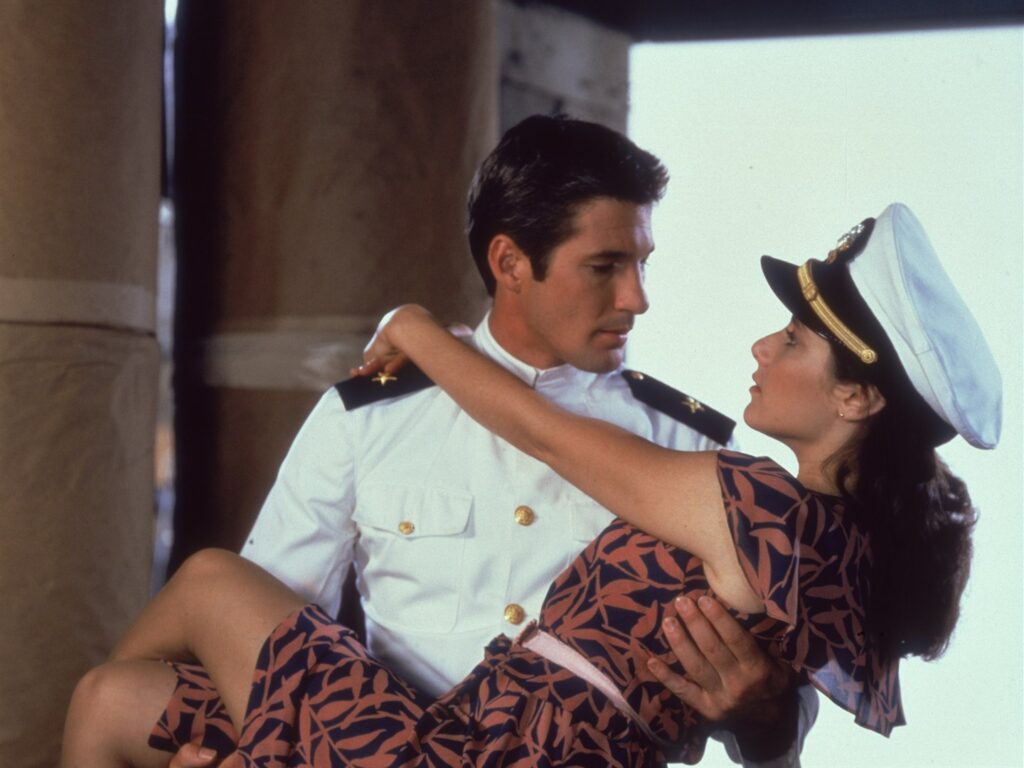
An Officer and a Gentleman
A three-year gap followed—until Taylor Hackford’s An Officer and a Gentleman delivered another triumph. Written for John Travolta (as Days of Heaven and American Gigolo had been), Gere took the part when Travolta passed. For his role he won a Golden Globe and, as a Buddhist, embraced the sex-symbol mantle with calm.
His five-year romance with Brazilian artist Silvia Martins ended amicably in friendship; he continued to champion her art shows and thank her for introducing him to Tibet.
Tibetan Home
Gere’s fascination with Buddhism began in youth, disillusioned with European philosophy. “Like most young people, I wasn’t particularly happy,” he recalls. “I often asked, ‘What’s this all for?’ Reading everything I could find, I discovered Sir John Woodroffe’s works on Tibetan Buddhism—and devoured them.”
By the time he traveled to India and Nepal, he was a seasoned Buddhist scholar able to converse with the Dalai Lama in exile at Dharamsala. “That meeting changed my life,” he says. The Dalai Lama gently challenged his acting training—rooted in Stanislavski’s system of living the character’s emotions. Buddhism teaches that emotions hold no intrinsic value, a notion that struck the Dalai Lama as amusing. “He laughed that I worked so hard to feel anger, hatred, sadness, pain, and suffering.”
A Methodist by baptism and a Mayflower descendant, Gere then walked across Tibet as a pilgrim and practiced in a remote mountain monastery. Though enchanted, he returned to Hollywood for roles his teacher deemed trivial.
Yet his name now gave him the freedom to choose films of personal interest. He helped Jim McBride secure funding for a Hollywood remake of Godard’s Breathless. In Francis Ford Coppola’s The Cotton Club he channeled his teenage passion, performing a trumpet solo on camera. He portrayed King David in biblical drama, declined a Superman role, and famously whispered to Bruce Willis at a crazed premiere, “Thanks for saving me from all that nonsense.”
By the late ’80s, Gere founded Tibet House U.S. and the Richard Gere Foundation, devoting himself to Tibet’s independence from China. He’s spent tireless years raising funds and global awareness for the Himalayan nation.
“In this cause I have traveled many stages,” he says. “My feelings now are very different from the anger I felt twenty-five years ago. Essentially, the Chinese are sowing the seeds of the nightmare they themselves will endure in future lives—and that calls forth only compassion. When Tibetans who spent twenty-five years in solitary confinement speak of the broader problem, they feel pity for those who became cruel. Such deep wisdom and kindness change your own consciousness.”
Pretty Woman
Gere initially resisted the lead in Garry Marshall’s romantic comedy Pretty Woman, finding the script banal and the character unappealing. But Marshall brought him Julia Roberts to meet over coffee, and Gere was won over: “She was simply amazing—like a rosebud.” Even so, it was his agent’s warning—he was in debt from philanthropy—that sealed the deal.
Richard Gere and Julia Roberts
“Pretty Woman” was meant as pure commercial fare, yet its success defied all expectations. At forty, Gere embodied every viewer’s idea of the ideal man, and he never escaped the role’s erotic aura. One obsessive fan threatened suicide unless he responded—forcing Gere into court to protect himself. Meanwhile, casual viewers assumed he and Roberts were lovers off-screen, though she later complained he never once invited her to dinner.
Then tabloids pictured him with a tall beauty, and the public suspected a PR stunt. If audiences had already merged Gere with his savvy businessman character, they cared little to distinguish between prostitute and supermodel.
Meeting Cindy Crawford
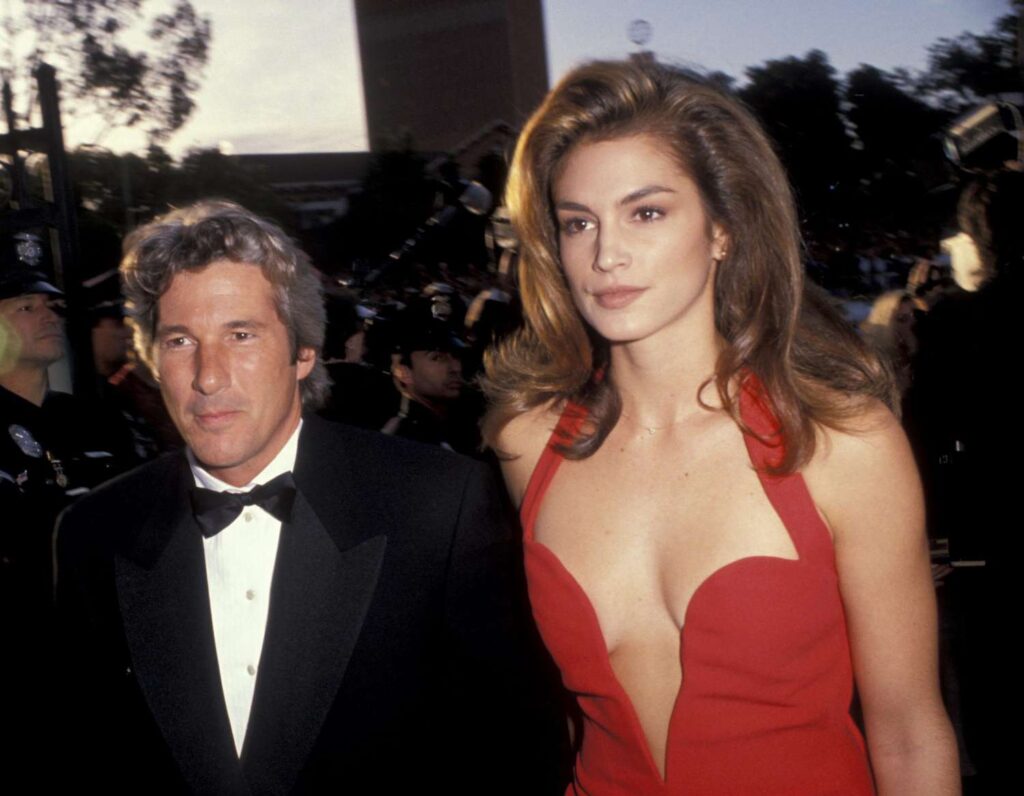
Gere met Cindy Crawford at photographer Herb Ritts’s studio—she sat with a towel on her head, her jaw dropped. At a later party she made her move, and soon they were meditating together in Amsterdam before holidaying in India, Nicaragua, Borneo, Bali, and Mexico—never as tourists, but as cultural explorers embedding themselves in each community.
Cindy Crawford and Richard Gere
They surprised everyone by marrying December 12, 1991, in Las Vegas: the bride and groom, two witnesses, improvised rings (some say aluminum from a costume jewelry shop, others gum-foil twists), and a total tab under fifty dollars.
Protecting their union from gossip cost far more. After scandalous stories branding Crawford a lesbian and calling their marriage “the biggest celebrity sham of the 20th century,” they bought a full-page ad in The Times for £30,000:
“We were married because we love each other and want to build our lives together. We are both heterosexual and monogamous and take our commitments seriously. There was no prenuptial agreement or contract. Rumors of our divorce are entirely false.”
By May 1994 they had quietly separated. On Oprah Winfrey’s show, Crawford explained: “At twenty I was happy to follow Richard — he led and I followed. But as I grew, I wanted to walk beside him, not a step behind. He wasn’t ready for that.”
Marriage to Carey Lowell
From the first moment I saw Carey Lowell at her photo exhibition,” he says, “I knew I wanted to marry her. That last step is always the hardest. Yet we chose a day, invited my son, Carey’s daughter, and a few close friends, and got married quietly, without any fuss.”
Richard Gere and Carey Lowell
Their son, Homer James Jigme Gere, was born February 2000 – his first two names honoring both grandfathers, the third a Tibetan word for “fearless.” “Of course it changes everything!” Gere says. “Having a child doesn’t turn you into someone else, but helps you become your truest self.”
“All I am in life is thanks to my wife,” he declares. “She’s incredible—caring with so many people, yet strong and loving. I remember every millisecond of the moment our eyes first met. It’s a power beyond words.”
Work and Life
In the new millennium, Gere learned tap dancing in his sixties for the musical Chicago. Two years later, for Shall We Dance? under Jennifer Lopez’s direction, he revisited his childhood ballroom lessons. For The Hoax—the true-life tale of a reporter who forged Howard Hughes’s biography—he even studied Kabbalah.
He seized every opportunity to speak against lies—both personal and political:
“At a press conference Nixon said he was no liar. In court Clinton said he never had sexual relations with that woman. Before invading Iraq, Bush said he knew where weapons of mass destruction were. As I see it, respected presidents could easily win any international contest for liars.”
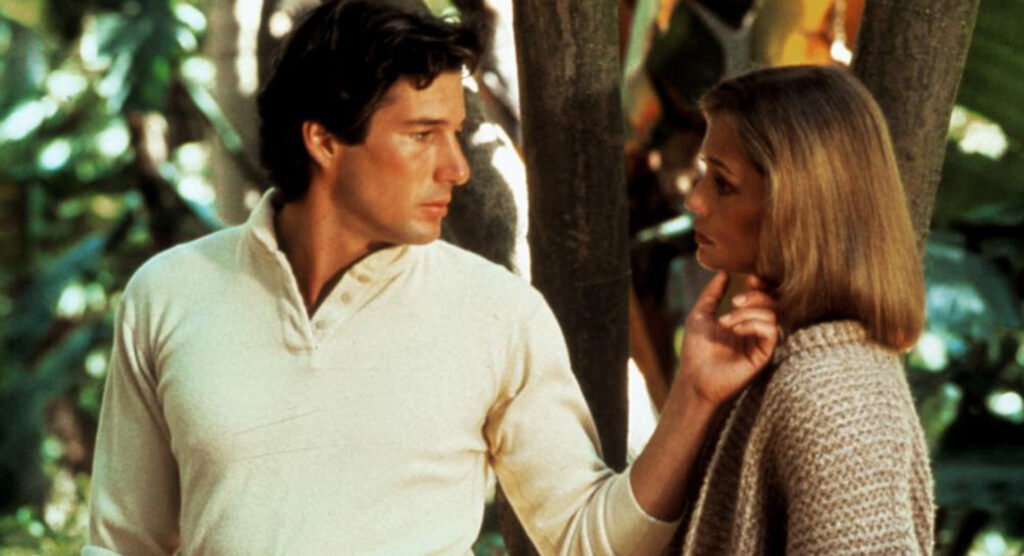
Diane Lane and Richard Gere, “Nights in Rodanthe”
With age, he’s become more outspoken on political issues. Banned in China, he meditates in India and meets frequently with the Dalai Lama. He funded repairs to the perilous road to Dharamsala so pilgrims could visit their teacher. He champions independence and human rights from Tibet to Chechnya, writing long letters to world leaders and articulating his views on politics, economics, and social justice with clarity. Yet journalists still ask more often how it feels to be a sex symbol.
Rumors occasionally surface that he’s quitting film—or finally divorcing. Fortunately, reality has dispelled both.
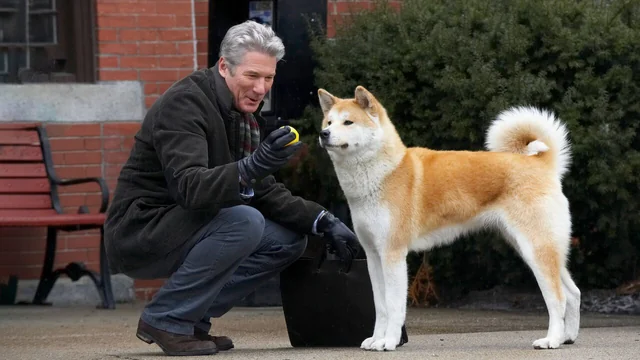
Richard Gere and Hachi
“Acting continues to feed me—financially, creatively, emotionally,” he says today. “But it’s not my life. My life is my family, my teachers in Tibet, and the joy of an evening spent with my child. Imagine—a fifty-something still asks me to read to him! I’d never give up that happiness.”