


Polishing Character
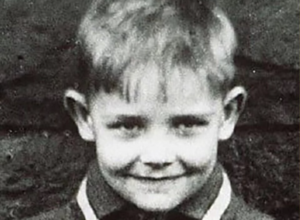
Thomas Sean Connery could, without exaggeration, be called a “slumdog millionaire“: Fountainbridge, where he was born on August 25, 1930, during the 1930s to the 1960s, was one of the poorest and bleakest districts of Edinburgh. Now, one of the houses in the area boasts a memorial plaque in honor of the celebrated local, although not on the very house where Joseph and Euphemia Connery rented a room: the building itself has been demolished, and the area has been redeveloped. Back then, young Tommy would excitedly look out of the window of his apartment building onto the endlessly long street with a pub opposite, and inconveniences like a shared toilet for several families and the lack of hot water did not bother him at all – that was just how everyone around lived.
A mix of Scottish and Irish blood, Tom’s primary inheritance, is a rather explosive combination… His first name was given in honor of his paternal grandfather; this respectable gentleman worked illegally as a bookmaker’s runner at the races and moonlighted as a boxer in parks.
“Fifty years later, I attributed many traits of Jesse McMallen, the slick criminal con artist from the movie ‘Family Business,’ to my grandfather, a cunning old fox and trickster,” the actor would later admit.
The future star’s parents chose a more prosaic fate: Joe worked in a factory and drove a truck, while Effie earned by cleaning. To help them, especially after the birth of his little brother Neil, Tom also went to work. The nine-year-old boy, who adored running around the football field more than anything, skillfully handled the milkman’s cart and brought home honestly earned three shillings every week, dropping a sixpence into the piggy bank.
(Interestingly, the future Bond also served the prestigious Fettes private school, which Ian Fleming “sent” his famous hero to attend.) As Alec Kitson, Tom’s senior “colleague” from his first profession (later a well-known union leader), recalled:
“He always had a smile and a joke ready for you. He was tall, well-built – and certainly, living in such an area of Edinburgh, you had to fend for yourself.”
At 13, independence forced him to leave school, and at 16, it led him to the Royal Navy. Three years later, he returned ashore with a stomach ulcer (the official reason for his discharge) and two tattoos: “Mum and Dad” and “Scotland Forever.” Thomas’s service record quickly filled with a variety of manual jobs: bricklayer, typesetter, coal deliveryman… Sometimes, due to his work, he even had to spend the night… in a coffin. The thing is, the sailor, discharged due to illness, was equated to the wounded and used the opportunity to learn a trade on free courses. He chose the profession of a polisher – and for some time worked as a specialist, polishing coffins. Sometimes, he worked so much that he had to stay in the workshop overnight, as there was nowhere else to sleep.
Around the same time, in addition to his passion for football, he started engaging in bodybuilding; this helped the 23-year-old not only to work part-time as a model in art schools but also to make an appearance at the “Mr. Universe” contest in 1953. Later, a narrative emerged that Sean had won “bronze” at the event. In reality, despite his impressive physique, he did not win any of the prize places. However, he did manage to draw attention to himself.
“I started from such a low base that the only way was up… – Connery recounted in an interview half a century later. – I learned on my own, which is probably why I still feel like a boy when I interact with intellectuals.”
However, after his first public success, the “universities” of life for the young Scot in his twenties began to take on a more humanitarian slant.
Choosing a Way

Like most of his peers, as a boy, Tommy adored “Western movies, with ‘good’ and ‘bad’ guys and cowboy stars like Tom Mix.” But he hadn’t even considered a career as a film actor at that point. However, after moving to the capital following his beauty contest win, the young athlete realized that he could earn a living not only through physical labor.
Sean Connery’s theatrical debut was in the chorus of the musical South Pacific at the Royal Drury Lane Theatre. Touring the country with this popular show, he met American actor Robert Henderson, who became his “theatrical guru.” Henderson gave the younger man several priceless pieces of advice. First, to turn down an enticing contract with “Manchester United“: “A footballer’s career usually ends at thirty, while an actor’s is just beginning.” Second, to develop not only physically but also intellectually by reading more. With an impressive reading list from Henderson (including George Bernard Shaw, Thomas Wolfe, Oscar Wilde, Henrik Ibsen, Marcel Proust, and James Joyce…), the budding actor spent his evenings in libraries across Britain, Scotland, Ireland, and Wales.
By recording “Hamlet” on tape, he worked on his pronunciation (though his distinctive Scottish accent never disappeared, becoming his “trademark“). He studied Stanislavski’s “My Life in Art” with zeal.
From the mid-1950s, Connery was active on stage, on television, and in films, adopting his middle name, Sean, as his stage name. On British TV, he played roles including Macbeth, Alexander the Great, and Alexei Vronsky. His first film role was much more modest – in the forgettable crime drama “No Road Back” (1956), he played Spike, a simple-minded petty crook. Sean Connery had few lines in his first “speaking” role, and he began to stutter in those he had, making his character not only a slow wit but also a stutterer.
“I never realized,” the actor confessed in an interview with Hello! magazine, “that the reason for my insatiable capacity for falling in love could have been simply because my mother, when I was very small, never hugged me or held me… It explains a lot, doesn’t it?”
The young actor caught attention after the TV movie “Requiem for a Heavyweight” (1957), which is about the dramatic fate of a former boxer forced to become a clown after an injury. The day after the broadcast, The Times condescendingly praised the lead actor for his “clumsy charm.” That same year, during the filming of “Action of the Tiger,” Connery met director Terence Young – who would go on to direct several Bond films.
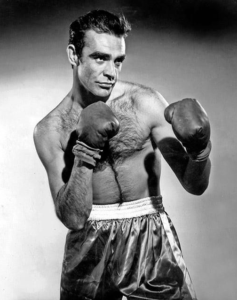
At 28, Sean finally landed a leading role in a film – in the melodrama “Another Time, Another Place.” His first success was accompanied by the first “sensational fact” that was a treat for the tabloid press: imagine the handsome Scotsman filming a scene with superstar Lana Turner when her lover – gangster Johnny Stompanato – bursts onto the set and points a gun at his rival! The future “super agent” didn’t lose his cool and disarmed the jealous lover.
A year later, he had a fairly successful debut in Hollywood with the fantasy film “Darby O’Gill and the Little People,” which critics called “not only one of the best Disney films but also one of the best fantasy adaptations.” But the real turning point in Sean Connery’s biography came in 1962.
The Birth of a Myth
The first adaptation of Ian Fleming’s book about the adventures of James Bond, a secret agent of British intelligence with a “license to kill,” initially did not promise to be a hit. Producers Harry Saltzman and Albert Broccoli first struggled over rights, then spent a long time searching for a suitable studio (the story was “too British” for Hollywood) and a director… There were financial issues, and casting the lead role caused serious disagreements. Various well-known stars and “promising beauties” fell through for different reasons: Cary Grant, David Niven, Richard Johnson, Patrick McGoohan…
“I never looked down on Bond, as many think. Creating a character like him requires some professionalism. Simply seeking other roles is a perfectly natural process.”
Then came a fateful interview for both the actor and the film – 32-year-old Sean Connery met with Saltzman and Broccoli. According to a semi-apocryphal story, the relatively unknown Scotsman impressed the producers most with his poise, and they finally saw him as the real Bond while watching from a window as he stylishly walked away from the United Artists office building. Perhaps there’s at least a grain of truth in this myth, considering how much effort and time the actor dedicated to perfecting his movements. It was no accident he spent an entire year studying with the famous dance teacher Yat Malmgren!..
Thus, a simpleton from a poor Scottish quarter was approved for the role of the impeccable polished British gentleman. Fleming was initially skeptical: “I imagined Bond not as an overgrown stuntman!” Only after the premiere of “Dr. No” did the author appreciate the “unrefined Highlander’s” performance and changed his opinion – as well as the hero’s background, adding Scottish ancestry. Actress Lois Maxwell, who played Miss Moneypenny in the first 14 Bond films, said that director Terence Young played a significant role in helping Connery embody Agent 007: “Terence took Sean under his wing. He took him to lunch and taught him how to behave, even how to conduct himself at the table“…
“I believe no other role can change a person as profoundly as the role of Bond. It becomes your cross to bear, a privilege, a joke, an ordeal. And it clings to you like a nightmare.”
Audiences first heard the iconic “My name is Bond. James Bond” on October 5, 1962. “That same week, Johnny Carson appeared on The Tonight Show,'”wrote Time,“and Pope John XXIII was on the cover of Time.
A couple of weeks later, the Cuban Missile Crisis would bring Khrushchev and Kennedy’s head to head. Who cared about the premiere of “Dr. No,” the first film based on Fleming’s books about James Bond, or about Sean Connery appearing as Her Majesty’s most charming secret agent? Who knew then?..”
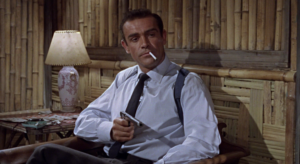
However, the success exceeded all expectations. With a budget of 1 million dollars, the film collected 6 million in Europe alone (the total revenue exceeded costs by almost 60 times!). President Kennedy, a big fan of Fleming’s books, watched “Dr. No” at the White House and, reportedly, sighed: “Too bad I don’t have guys like that on my team!..” Sean Connery literally woke up famous.
Years of Triumph
As the actor himself said in an interview – “a lot depends on the context of the times. Bond appeared to the public after the war when people were fed up with ration coupons, dull tones, and practical clothing in shades of gray for all occasions. And then comes a character who… cuts through all that routine like a sharp knife through a piece of butter – with all his suits, cars, wines, and women…”
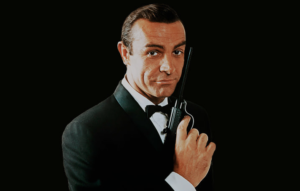
Indeed, agent 007 became a true pop icon of the 60s. The hero of the time was independent and decisive, adventurous and elegant, cruel and charming – such a peculiar cocktail of qualities (“Shaken, not stirred!”) Connery demonstrated on-screen with exceptional success. He himself, however, considered Fleming a snob and his hero too pompous. Connery saw his contribution as bringing a sobering irony to the character: “In Fleming’s books, everything was serious, and that’s a flaw. In the very first Bond film, I infused the character with humor… I disagree with critics who take the Bond films too seriously. They have farcical props and a plethora of purely comedic conventions, and the plots themselves are absurdly funny. Bond is a grotesque.”
From 1962 to 1967, Sean Connery starred in five James Bond films: “Dr. No,” “From Russia with Love,” “Goldfinger,” “Thunderball,” and “You Only Live Twice.” His fees and popularity soared, with the last of these films adding a percentage of the profits to his income. Between shooting the next chapters of the trendy saga, the actor played entirely different characters – in Hitchcock’s thriller “Marni” (1964), the war drama “The Hill” (1965), the comedic melodrama “A Fine Madness” (1966)… Connery eagerly took the opportunity to play a real villain in “The Wicker Man,” hoping to prove his versatility as an actor. But by then, the label had firmly stuck, and the audience preferred to see their favorite only as the impeccable superagent.
Bond’s Girl
The years of Agent 007’s first triumph and first disappointment coincided with Connery’s years of first marriage, from the romance’s beginning to the marriage’s collapse. In 1957, on the set of the TV movie “Anna Christie,” Sean met Australian actress Diane Cilento. At the time, she was married to writer Andrew Volpe (they had a daughter that same year). Five years later, on November 29, 1962, Diane and Sean secretly married in Gibraltar, and their son Jason was born just a month and a half later.
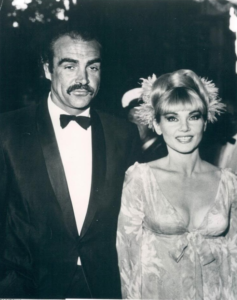
Both spouses were artistic, independent, eccentric, and temperamental individuals. Typically, such traits in partners foster mutual passion but not a stable marriage… Actor Michael Caine, a friend of Connery’s, told Rolling Stone magazine in an interview:
“Once I was with them in Nassau. Diana was preparing lunch, and we left. One thing led to another – in short, we were two hours late. As soon as we opened the door and Sean said, ‘Darling, we’re back,’ everything she had prepared flew at us. I remember us standing there, all covered in beans and sauce…”
However, Diane herself claimed that it was Connery who was quite harsh with her and even raised his hand to her. She shared this with the world in her autobiography “My Nine Lives,” published in 2006. The actress essentially also blamed her husband for the breakup, complaining:
“Sean wanted to see me only as a wife at the hearth and snapped at colleagues who offered me film work. He preferred that I stay at home with our son Jason and make Sunday breakfasts for him and his golf buddies… Sean was unable to cope with the fame that the role of James Bond brought him. He changed, as did our relationship.”
Connery, of course, vehemently denied his ex-wife’s accusations of violence, but he found it not so easy to defend himself after he once said in an interview with Playboy magazine in response to the question,
“Bond often hits women. What do you think about that?” He answered: “I don’t think it’s that bad.”
His reputation wasn’t much cleared by the qualifications that followed this admission: “However, I don’t recommend hitting a woman in the same way you might hit a man. An open-handed slap is justified if all other alternatives fail and there has been plenty of warning..” These rash words became closely intertwined with the brutish image of the spy “womanizer” and haunted its performer for decades.
In 1973, Sean and Diana divorced. By that time, the actor’s relationship with the Bond franchise had also reached a “divorce,” although it was still temporary at that point. In the Western “Shalako” (1968), he starred alongside Brigitte Bardot, charming all his co-stars on set, not afraid to clash with the director, and boldly rewriting the drawn-out script; in the historical drama “The Molly Maguires” (1969), he had the opportunity to recall his “working-class roots” to lend authenticity to the role of the leader of a group of Irish miners fighting social injustice.
Both films were praised by critics for the talented performance of the lead actor, and both failed to achieve significant success. Meanwhile, in 1969, the role of the already famous agent was played by George Lazenby in “On Her Majesty’s Secret Service,” but the Australian’s performance failed to convince the audience, so Saltzman and Broccoli persuaded Connery to return.
The offer he couldn’t refuse was a fee of $1.2 million for “Diamonds Are Forever” (1971)… which the lead actor donated to the Scottish International Education Trust, which he had established.
“I can get very upset over a $5 bet in golf, and yet I can give away a million dollars,” the actor later said.
Incidentally, golf, which Connery seriously took up, adopting the hobby of his most famous character, and which Diane Cilento very jealously and unfavorably mentioned in her book, played a significant role in his life. Thanks to this new sporting passion, he met a woman with whom his relationship turned out to be much more stable than with his first wife.
70s-80s
In 1970, at a golf tournament in Casablanca, Sean Connery met the artist Micheline Roquebrune. He won among the men, and she among the women. Family lore says that Micheline, who fell in love at first sight with the tall, handsome man, didn’t even recognize him as the world-famous “Agent 007.” Initially, the Scotsman and the half-French, half-Moroccan woman hardly understood each other, something the actor recalls with humor: “Fortunately, we couldn’t engage each other in boring conversations – that’s why we got married so quickly.” In reality, it wasn’t that quick – they married in 1975: like Connery’s first marriage, his second was also conducted in Gibraltar (where registration requires minimal time and documentation) and without any publicity. Since then, Sean and Micheline have been one of the rare examples of a long-lasting and harmonious union in the acting world.
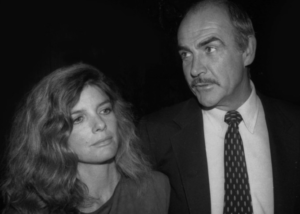
Many things in Connery’s life changed. He tried his hand at directing, making the documentary film “The Bowler and the Bonnet” (1969) about Scottish dockyard workers, engaged in production work, purchased a luxurious villa in the ancient Andalusian city of Marbella on the Costa del Sol, and moved from Britain to warmer latitudes – by his own version, “until Scotland becomes independent,” and according to the press, to escape British taxes. (In 1998, the villa was sold, and a decade later, the elderly actor was called to court on suspicion of irregularities in the transactions and money laundering.)
As for his acting work, the first half of the 70s for Connery was marked by a departure from Bond. In films of that time – “The Offence” (1972), “Zardoz” (1974), “Murder on the Orient Express” (1974), “The Wind and the Lion” (1975), “The Man Who Would Be King” (1975), “Robin and Marian” (1976), Connery successfully “tasted” the most diverse genres and roles – from fighting the power of an omnipotent computer in a fairy-tale dystopia to a militant Arab Sheikh in a historical adventure film.
A stand-out in his filmography of those years is perhaps “The Red Tent” (1969). In Mikhail Kalatozov’s drama about the tragedy of General Nobile’s Arctic expedition, Connery played the legendary polar explorer Roald Amundsen. After such a serious role, Soviet film critics spoke of him with respect, highlighting his proletarian background and critique of the enemy agent character. “I will play only real roles in real films,” a correspondent for “Ekran” quoted Connery as promising. Yet, if “real” cinema is considered to be films not primarily aimed at entertaining the audience, it must be acknowledged that the actor received not so many roles in such films…
Despite all his “anti-Bond” statements, the role of Agent 007 once again “caught up” with its first performer. In 1983, the unofficial Bond film “Never Say Never Again” was released. According to the most popular version, it was his beloved wife who persuaded Sean to “revisit the past,” and she also suggested the significant title for the film. It proved to be prophetic. Although Connery never appeared on-screen in this role again after that, in 2005, he voiced the famous agent in a video game based on the film “From Russia with Love.”
Second Wind
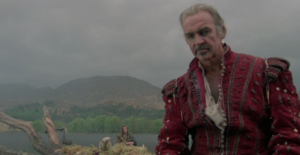
The 1980s marked a period of “second wind” for Connery, featuring fresh discoveries in acting mastery and another wave of popularity. Critics noted that his new roles were often as teachers, mentors, and elder statesmen.
In the fantasy action film “Highlander” (1986), he played the mentor of the main character, and in the adventure film “Indiana Jones and the Last Crusade” (1989), he portrayed the father of the main character… The strong “father figure” suited the actor perfectly, who had acquired noble silver hair and an even more piercing gaze. In the 1987 gangster film “The Untouchables,” his character, an experienced police officer, teaches life lessons to Agent Ness, who is leading the fight against Al Capone.
For this role, Connery was finally honored with an Oscar. Although he later remarked with his characteristic irony that he “would have preferred to win the U.S. Open in golf,” his introduction at the ceremony: “My name is Connery. Sean Connery” – was spoken with genuine pride.
For the role of monk William of Baskerville in the adaptation of Umberto Eco’s postmodern novel “The Name of the Rose” (1986), Connery received more modest awards. However, this film, coldly received in America, was a colossal success in Europe. In the Old World, the sophisticated and intelligent film, which combined several genres – from historical to comedic, gathered a much more significant box office than the daring adventures of Bond. In “The Name of the Rose,” Connery’s character was again a wise and insightful mentor, but his understanding of the world here was far deeper than the usual worldly wisdom of Hollywood “dads“…
“More than anything, I would like to become an old man with a good face, like Hitchcock or Picasso,” said the actor.
Indeed, such a face, only enhanced by a gray beard, looked confidently and unflappably from movie posters and magazine covers in the 80s and 90s. When Sean Connery was named by “People” magazine as the sexiest man alive, he was already 60. Ten years later, the same authoritative publication named him the sexiest man of the century.
In the 1990s, the actor was so active that listing his works would take an entire paragraph. Each of his characters was unmistakably charismatic – whether it was the doctor selflessly searching for a cure for cancer in “Medicine Man” (1992), King Arthur in “First Knight” (1995), the villain Winter in “The Avengers” (1998), or the reclusive writer in “Finding Forrester” (2000)… However, none of the films in which he participated turned out to be a blockbuster or a masterpiece of art. The last film in which Connery had a leading role, “The League of Extraordinary Gentlemen” (2003), was mercilessly criticized as “senseless entertainment with special effects and explosions.” Yet, no one had any complaints about Sean Connery’s performance.
Fans still dreamed about him, and journalists still pursued him. And on July 5, 2000, the great actor was knighted. As with the Oscar, the press and fans typically reacted with a “Finally.” It was speculated (perhaps not without foundation) that political beliefs had long prevented Connery from being knighted: an active member of the Scottish National Party, he always openly expressed “separatist” views. However, at the award ceremony, he expressed impeccably polite gratitude:
“I have never been so proud and happy as I am today.”
“Spicy” facts in Connery’s memoirs
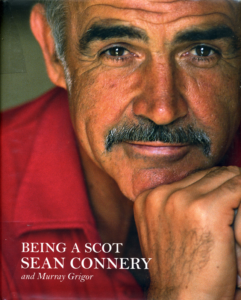
His belief that “Scotland should always stand independently in everything” was most vividly expressed in Sean Connery’s autobiography “Being A Scot,” co-written with writer Murray Grigor and published in 2008. Journalist and publisher Graham Rae warned readers that anyone looking for “intimate details or ‘spicy’ facts in Connery’s memoirs would be completely disappointed,” instead finding “a very interesting and intelligent narrative about what Scotland has given to the world in science, art, and other fields.”
Interestingly, Connery always reacted sharply to any encroachments on his peace (he sued film companies, journalists, biographers, his agent…), promising his version of events – “everything as it really was.” Yet, in the end, he revealed nothing to the world about his private life, instead sharing entirely different stories.
About his views on Ossian, Walter Scott, and Robert Burns, his discussions with Umberto Eco about the Templar Knights, and the peculiarities of Scottish industry… Fans discovered a “different Connery” – the author of these memoirs did not magically transform from a muscle-flexing youth and a brave young man juggling weapons into a thinker engaged in politics and culture. The public had observed the “red carpets,” “walks of fame,” and other external attributes of “stardom” for decades – and then was shown the inner life behind that facade, filled with thought, search, and self-development.
The only section of the memoirs where Sir Sean vividly and openly talks “about the personal” is the memories of his childhood years in Fountainbridge, emotional descriptions of colorful relatives, passion for football, and beloved horses he cared for as a “transport worker” at a dairy… These detailed stories largely explain a trait noted by many of his acquaintances and biographers – the habit of counting every dollar. “I’ve always valued what money gives,” Connery states directly. “I’ve never believed that only the poor can be good people. Once upon a time, I experienced poverty and do not want to go through it again.”
“I love rewriting scripts; it helps me bond with my character. My text always has more irony and humor than the script. I think if you don’t approach life with humor, it will drive you mad. In Scotland, about people like me, they say: ‘He has an iron neck.'”
Summarizing his long journey from a poor district to the heights of world fame, Connery describes it as “liberation from the burden of ignorance.”
And he wasn’t pretending!


